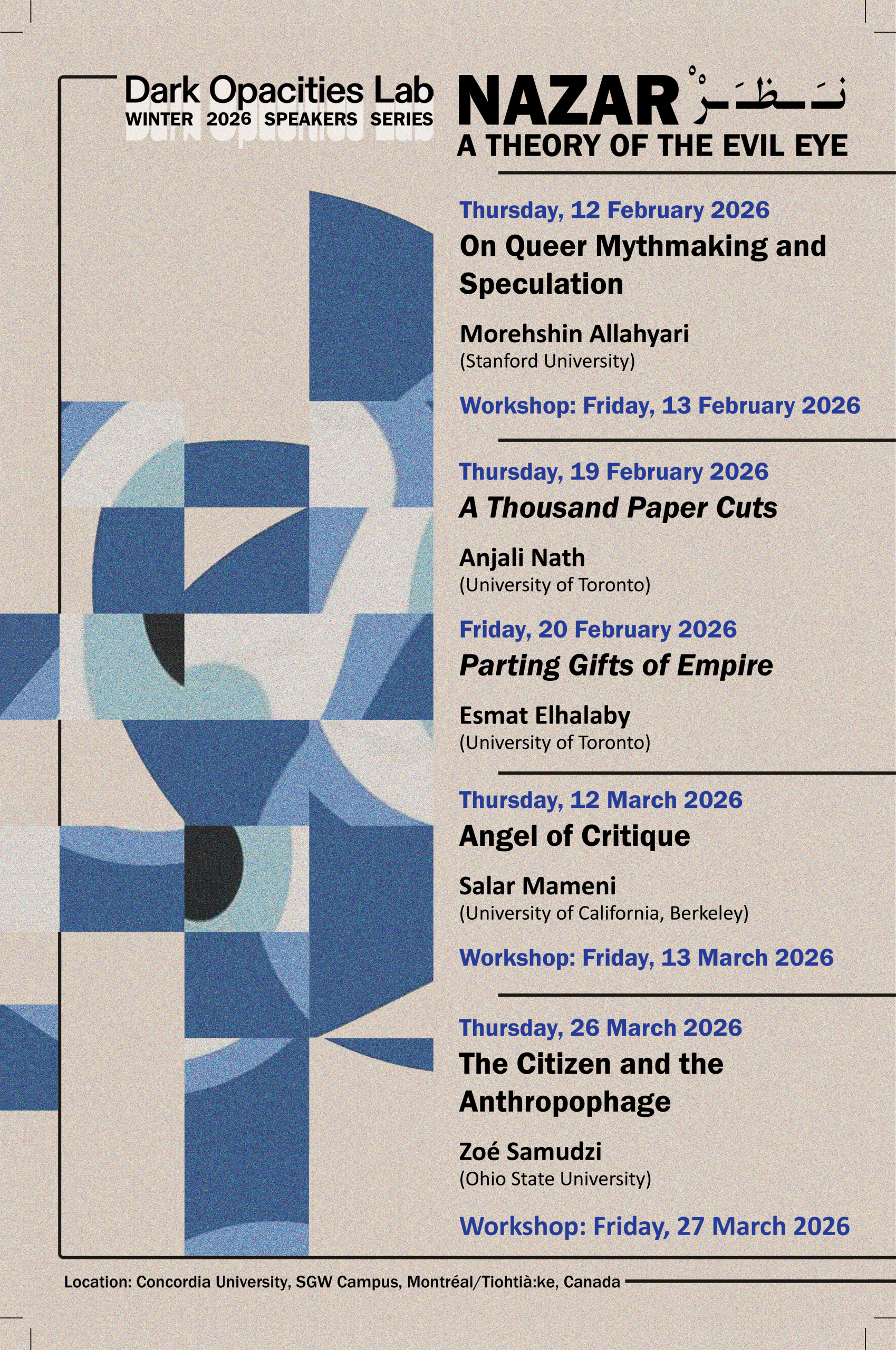
A Thousand Paper Cuts
 AN-EE.jpg
University of Toronto Mississauga
Anjali Nath is Assistant Professor in Institute of Communication, Culture, Information, and Technology at the University of Toronto Mississauga. Her work focuses on the visual culture of American militarism, with a focus on document redaction, transparency, and the archives of state violence. Her current book project, A Thousand Paper Cuts: US Empire and the Bureaucratic Life of War, is a critical reckoning with the racial and imperial work of paper as mobilized in the service of American militarism. Nath’s research has been supported by the Charles Warren Center for Studies in American History at Harvard University, the University of California office of the President, and the UC Davis Humanities Institute. Her essays and writing have appeared in American Quarterly, Cultural Studies <=> Critical Methodologies, Studies in Documentary Film, Visual Anthropology and elsewhere. Nath co-edits the newly inaugurated Critical Militarization Studies book series on University of Michigan Press, with Dr. Crystal Baik. Prior to joining the faculty at UTM, Nath held positions at University of California, Davis and the American University of Beirut.
Dark Opacities Lab is pleased to welcome Anjali Nath, author of “A Thousand Paper Cuts” for a talk on her book, with response and in conversation with Dark Opacities Lab director Balbir K. Singh.
About the book:
In A Thousand Paper Cuts, Anjali Nath considers the paper worlds made and destroyed by US imperialism. From the slogans of anti-Communist Cold Warriors against a spectral “Paper Curtain” to the scuttled efforts of activists who sought to document America’s surveillance regime amidst the US war on Vietnam, Nath offers a pre-history of the redacted visions of the Homeland Security age. Nath shows how declassified documents tell the story of American counterinsurgency at home and abroad, revealing the imperial grammar beneath the abundant redactions of contemporary visual culture. Tracing the liberal political rhetoric that inspired the Freedom of Information Act in the 1960s, through to the Bush-era’s exuberant secrecy to the contemporary artists who subversively repurpose redacted documents in collage and critique, Nath maps the formation of the security state, its bureaucratic regimes of surveillance, and the racial logic of transparency.
About “Nazar: A Theory of the Evil Eye”:
Nazar is traditionally used as an amulet or talisman to ward off the evil eye and attendant feelings of jealousy or envy; it is generally understood in interpersonal terms and invests in a particular suspicion and superstition that is widely known across many parts of the global South, especially within global Islam. For the purposes of developing an anti-colonial theory of sight, we offer Nazar as a framework in which to triangulate race, colonialism, and psychoanalysis.
We ask: What might it mean to think about surveillance and racist technology using Nazar as an animating framework? If we understand the harm caused by sight as surveillance, oversight, or violent watching, what might it mean to reconsider it as a protective or healing power, necessary and potentially having its own kind of magic?