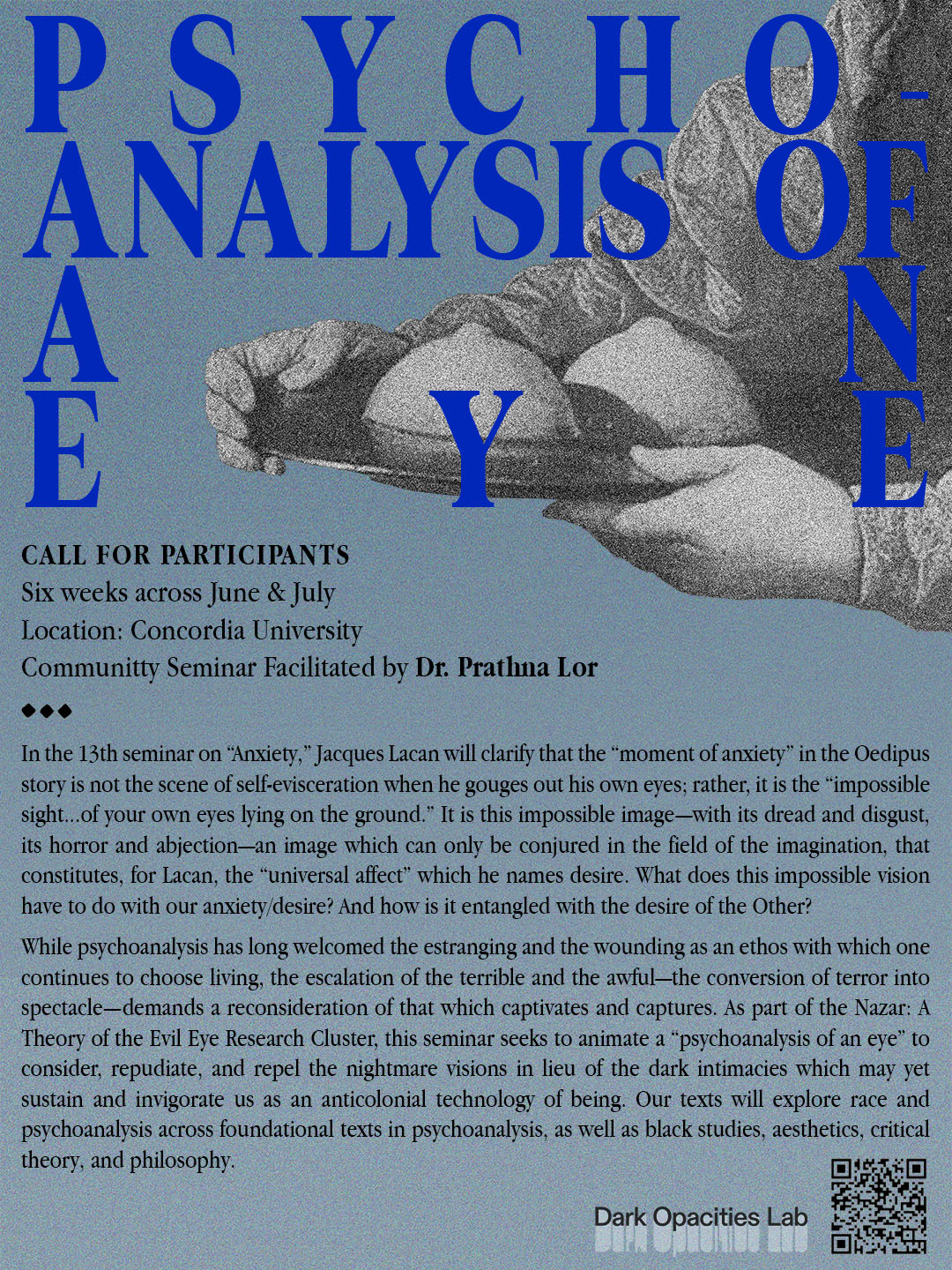
Nazar: Zine Volumes 1 + 2
 Vol_1_cover_opened_draft_Aug_18-scaled-e1762276683773.jpg
Volume 1: Study in Nazar
Contents
Editor’s note
Nazar Vignettes & the Dialogic
Unblinking Eyes
Surmah, Nazar and the Politics of Protection
Dream
Cobalt Blue Spaces: Nazar as a Freedom of Movement
To Gaze Confrontationally!
Speculative Questions
Editor’s note
Nazar —from Arabic meaning sight, surveillance, attention—has appeared across cultures for thousands of years as humanity’s response to the violence of the evil eye. Blue glass beads, hamsa hands, protective amulets—these appear across cultures as shields against envious gazes.
These practices recognize that sight itself can be weaponized. These pieces trace nazar through protective surmah inscribed with Quranic verses, warnings delivered through dreams, cobalt blue spaces that shelter bodies from harmful observation, and confrontational gazes that refuse to look away. Through conversations with scholars and artists, we’ve learned how ancient protective knowledge speaks directly to contemporary surveillance.
Nazar isn’t just about protection—it shows us how certain bodies get marked as threatening, certain communities rendered suspect. Right now, as cameras track our movements and algorithms sort our faces, these seek practices and strategies for resisting systems that demand our perpetual visibility.
Communities have always known that survival sometimes requires opacity, strategic withdrawal from sight. This creates disruption in the smooth operation of surveillance. In the blue glass of the nazar bead, we find both ancestral wisdom and contemporary strategy.
Nazar Speaker Series
Winter 2025
Nazar, Capture, Liberation
February 20, 2025
Maryam Kashani & Kameelah Janan Rasheed
New Books in Nazar
March 26, 2025
Ariella Azoulay & Kimberly Juanita Brown
Reverie of Resistance
April 9, 2025
Lara Sheehi & Stephen Sheehi
Nazar Vignettes & the Dialogic
I. Tarik Dobbs’s poem “My brother was born both ally and combatant” is bookended with the line “All voyeurism begins with surveillance.” This striking bookend to the poem is in specific relation to Palestine, where the dual meaning of voyeurism is crucial to understand. The simultaneous pleasure, sexual or otherwise, gleaned from viewing an other’s body on the one hand, engaged in sex acts, or on the other hand, in pain or distress, is one framing in which we might understand how Isr**li skill and investment in the carceral project of surveillance is rooted in pleasures gleaned from the degradation and suffering of Palestinians. The kind of watchfulness of Isr**li forces, human and technological, is not without its appetites–the pleasure derived from such violence is not to be mistaken for anything other than what it is: when somebody shows you who they are, and what they gain pleasure from, believe them. Believe that they are genocidal and maniacal and to be fought against and resisted with all of what you are and who we are and what we will rise up against time and time again, against Zionism, against fascism, against global white supremacy. Do not for a second think that you or we are outside of this loop of voyeurism as it begins with surveillance.
The visual is so crucial to this particular line, complemented by the poem’s broader investment in other senses: “a hot light eats his entire body” with the gustatory; “ :: Like his warm gun ate his jacket’s lining//His jacket’s lining was wool ::” with the haptic and material. The poem emanates with feeling, with the multi-sensorial, to underscore the visual’s automatic investment in policing, in distinguishing, in recognizing, in reading as ways of watching, watching over. What that does for thinking with the psychoanalytic cannot be undermined, insofar as the policing mechanism is not one that is separated from the gaze in all of its manifestations (male, oppositional, Black, and so forth; Mulvey, hooks, Campt). The act of looking, of seeing, is often an act of watching, oversight, of sur-veillance ; surveillance always already laden with the possibility of voyeurism, as Dobbs emphasizes.
It is in Nazar that we are repulsed by the voyeur, by the surveillant eye, and we repel it. We take your blue eye and use it against you, from birth until our last breath. This is our inheritance, an antagonism we acknowledge and work against.
II.
“Each night without fail, she prayed for blue eyes. Fervently, for a year she had prayed. Although somewhat discouraged, she was not without hope. To have something as wonderful as that happen would take a long, long time. Thrown, in this way, into the blinding conviction that only a miracle could relieve her, she would never know her beauty. She would see only what there was to see: the eyes of other people.”
To cloud one’s own vision of oneself with the eyesof other people, to be caught up in perception: how true, how banal, how devastating. The desire for blue eyes, by young Pecola. The peculiarity of such desire engrained as a standard of Western, white supremacist beauty standards, yes. But the impossibility, the hope, the blindness to her own beauty, the sheer weight of it. The indignities of the gaze, of an other’s perception, of the fear and freezing in racial self-loathing.
Published in 1970, Morrison’s novel includes a foreword that informs readers of the real-life conversation with her friend some twenty-years prior that informed the core of the novel’s premise, questioning such desire thusly: “Implicit in her desire was racial self-loathing… Who had looked at her and found her so wanting, so small a weight on the beauty scale? The novel pecks away at the gaze that condemned her.” In ‘pecking away at the gaze that condemns’ what might it mean to consider such an active gesture as pecking as one that is at once loving and destructive, a kiss and a bite, a staying with the racial self-loathing as a means to break it down, with love and rage, care and frustration. This last notation is core to theorizing Nazar insofar as it invests in the logic of protection in the face of antagonism, in breaking down and destroying the kind of dehumanization and devaluation of life and dignity for racialized peoples, for the global majority.
III.
The way I pronounce nazar is from its usage in Panjabi. I heard it first from my mother, who following one of our very long gurdwara Sundays, would peel badham for us and we would gossip, not so much about other teenagers like my younger sister and myself, but about the aunties: the fear they inspired, the awe, thefrustration. My mom was one of the aunties, her role to the outside–in the gurdwara halls and parties and sangeets and weddings. Her conception of nazar and of the evil eye was borne out of superstition yes, but also out of the very real and complex forms of envy that attached themselves psychically, but often via displacement. If there existed any slight or antagonism between my mother and an auntie, that evil eye was being planted on us daughters. Nazar, as a talisman, as she explained it to us, was about protecting those most vulnerable, and us kids were vulnerable, prone to the gaze displaced from adult not to adult, but from adult to child or adult to the sick, the elderly, the yet-to-be born. This displacement is important, this movement from a kind of symmetrical power, a similar scale–to asymmetrical power, to uneven scales, to target the less fortified, the less powerful. Protection from this asymmetry and displacement became requisite, I understand now.
Unblinking Eyes
i. Different cultures have their own versions of the evil eye. In Ethiopian and Eritrean cosmology, we call it buda , a spirit possessing the power of the evil eye, capable of casting spells with a mere glance. To label someone buda is a serious accusation, as the term is weaponized to mark those from lower castes—metalworkers, potters, lepers, and anyone—who are thought to inherit this power through bloodline. This is so deeply embedded in Ethiopian and Eritrean culture that even the Amharic word for manual worker, tabib , is also used to denote “one with the evil eye.”
In rural areas, where hyenas are the most feared manifestation of buda, their human forms betraying themselves through large, unblinking eyes that never break contact.
ii. When amulets or talismans like nazar are inaccessible or don’t work, how do we shield ourselves and others? Witnessing (shahada) —a form of seeing that can be both ocular and spiritual—is a form of faith, and that grief, when held in common, becomes both archive and shield. Maybe our protection lies not in amulets or talismans alone, but in learning to see each other—with eyes that hold rather than hunt, that witness rather than surveil. The same gaze that marks blacksmiths as buda, that render Blackness as threat or disappears us, can be transformed into eyes that protect. Maybe the most powerful talisman is the promise that someone will search for us if we don’t come home. That our names will be remembered. Perhaps what I desire is not the blues of the nazar but the blue we turn to under moonlight.
Surmah, Nazar and the Politics of Protection
“The disbelievers would almost cut you down with their eyes when they hear ‘you recite’ the Reminder…”
Surah al-Qalam (68:51)
Nazar follows us in every facet of life. In Surah al-Qalam, the Qur’an has warned of the malefic gaze. Being cut down with the eyes that carry consuming looks riddled with envy that threaten, and require protection. The sight canbe violent, and so the cosmology offers refuge:
Surmah/Kohl, the deep black power rimming the eyes, is one of the oldest technologies of defense against survaillance. This technology of care, shields the eye from the eye . In Persian cultural practices, it became woven into the routine of women’s daily life and passed down through generations to ensure spiritual security. As a step in the Persian Haft Qalam beauty regime, it invoked cosmology and spirituality. While now may be dismissed as decorative, these rituals intended to beautify the face while veiling the wearer in a layer of protective opacity. In addition to its spiritual use, Surmah was seen as medicinal, used to strengthen the sight and safeguard the body’s most vulnerable threshold. The Prophet Muhammad is said to have applied ithmid kohl to his eyes three times in each eye before sleep. Its qualities should not be limited to gender expression or age. Whether a mother applies surmah to the eyes of her newborn to ward off evil, a young boy marked with familial care, or an elder who has traversed through life, their eyes are marked all the same. We are all deserving of protection. We all deserve to be witnessed through gentle eyes in reverence and protected from those seeking to undermine and dismantle.Today, in the age of digital surveillance, racial profiling and biometric sorting, the act of lining the eyes with Surmah becomes a counter gesture. While our ancestors may have worn it for protection and routine, we wear it for opacity and anonymity. A withdrawal. A boundary between the exterior and how it is perceived internally. To line one’s eyes with Surmah, encrypts one’s cosmology with lineage, memory and refusal.
Dream
That Sunday morning, I encountered my late grandmother in a dream. I didn’t see her face, but I could smell the Nabulsi olive soap she always used—nothing else would do. Its scent, thick and earthy, would linger for seven days. In the haze of that dream, I could feel her watchful gaze over me.
When I awoke, I found it: a pale hijab*, tucked into the pocket of a shirt I hadn’t worn in weeks. She must have com to warn me. To prepare me for the violence to come. A few days later, that same pocket held another kind of object. A screen. The same one through which I would watch my homeland unravel, engulfed in monstrous rings of fire. Smoke rose from streets I’d walked, under a sky full of unblinking machines: aerial, imperial, and lethal. These were the new faces of modern warfare: lethal surveillance technologies, mass-produced and packaged for export. A form of erasure perfected through genocidal violence. A gaze calibrated to identify, to follow, to eliminate. A gaze that knows no tenderness.
And still, I carry my sitti’ s hijab. Folded quietly. A reminder that there are other ways of seeing.
Cobalt Blue Spaces: Nazar as a Freedom of Movement
Nazar offers a form of protection that is mobile, atmospheric, and relational. It does not submit to the terms of recognition demanded by racialized systems of control, like predictive policing or algorithmic vision.It does not feed the machine that renders the Muslim body as suspicious or pre-criminal. It offers shelter through partiality and shadow. When I think of Nazar, I do not merely see an amulet or a charm; I feel a safe space. A safety that is not made possible by a wall or a fence but by an intention, a gesture, a ritual, and a dance. In a Nazar space, the body can move under the cobalt blue shadow of Nazar, a color that cannot be captured by surveillance cameras.
Nazar is a way of shaping space: creating concealments where movement and freedom are possible because full visibility is refused. Similar to the Bay Area, where Muslim communities create delicate territories, spaces of gathering and shelter inside the very system that demands their exposure. Take, for instance, Fatemeh, a first-year student at Zaytuna College in Berkley. Though quiet and cautious in public, she chose to represent herself by a performance in a garden at night, under her own terms. Her staged recitation was playful but cloaked in darkness to refuse to be extracted into visibility. It marks a space of belonging through repetition and concealment.Here, the courtyard becomes a cobalt blue space shaped by refrains: small, rhythmic, and repeated gestures that function as an act of territorialization in the midst of chaos.
.
The state tells us that safety comes from being documented and verified. But for many of us, especially those marked by race, gender, or migration, survival depends on what remains unseen. However, Nazar teaches us that those spaces that are commonly known as “unsafe” spaces are the ones hidden from official sight: alleyways, shadowed corners, the half-abandoned lot at the end of a dead-end street. These spaces, however, were practically the safest for the body to move. Even there, in the margin, we can dance a territory into being. A cobalt blue space is not a spotlight; it is a shadow that nurtures. It is a place where you are overlooked, and thus, protected. It invites freedom of movement.
When I walk through the city, I look for these “cobalt blue spaces.” Some I find—the overlooked, the unnoticed. Some I build by how I carry myself, how I refuse the pull toward exposure. Sometimes, simply knowing how to move quietly, how to blend, how to shimmer just outside the center of attention, is a way of conceiving a nazar into the world. Sometimes, survival is possible only in the spaces where we are not seen. Nazar, as we have been taught, reminds us that invisibility, too, can be a sanctuary, a “home.”
To Gaze Confrontationally!
Every act of looking carries with it histories of power, exclusion, and defiance. In systems shaped by domination, the gaze is never neutral. It decides who is acknowledged, scrutinized, and remains unseen. Under these conditions, to be visible is not to be recognized but to be exposed. Yet, people have crafted ways to shield themselves from this extractive seeing across time and cultures. They’ve offered gestures and objects that do not erase the gaze, but redirect it toward relation, toward care. The Nazar belongs to this lineage. More than ornament, it is a refusal—a way of saying: not all eyes are welcome here. It carries the force of the oppositional gaze, which bell hooks describes as the act of looking back—of insisting on presence where there is pressure to disappear. “Not only will I stare, I want my look to change reality.” This is not a reactive gaze—it generates space for resistance.
Under the forces of racial capitalism, colonial rule, and patriarchal control, being seen often means being unprotected. Ruha Benjamin reminds us that “privacy is not only about protecting some things from view, but also about what is strategically exposed.” In such a world, to look back becomes a strategic way to protect one’s privacy and community. The Nazar lives here, not only as an amulet, but as an ethic. A way of seeing that shelters rather than dominates. For those once forbidden to lift their eyes, even a glance becomes a quiet revolt. It is not only about vision; it is about reclaiming the right to witness and exist. Benjamin calls on us to cultivate “a liberatory imagination in everyday life.” This imagination is part of Nazar . It lives in gestures and everyday rituals passed down through generations. I remember my grandmother braiding our hair, whispering Ayat al-Kursi under her breath, then placing her hand gently on our foreheads. She would say, “I feel at ease now; go and play.” She was a widowed woman from the working class who had learned to be fierce; she spoke up for her rights and those of her entire family. Her strength was not just in protective rituals, but in the way she acted and resisted being silenced. These were her ways of shielding her loved ones. They were forms of care, living knowledge that resisted harm.
Therefore, to gaze confrontationally is to declare that not all eyes are surveillant. Some protect. Some hold. Benjamin reminds us that surveillance is not only a technical issue but also an ethical one. It relies on “fixed notions of ethno-racial difference” that shape “vertical realities.” The Nazar doesn’t simply block harm; it interrupts the order that makes such harm possible. To look with care and be seen with dignity is the radical recognition hooks calls forth; a vision sustained through community, where looking becomes a shared act of protection, memory, and survival.
After Bhanu Kapil’sThe Vertical Interrogation of Strangers—
1. What is your association with Nazar?
2. Who is responsible for your protection?
3. Where do you often see the talisman?
4. What frustrates you about Nazar?
5. Tell me about whom you are mourning?
6. What do you fear about the evil eye?
7. How will you confront it?
Volume 2: How to Nazar
Contents
Speculative Questions
Blue Light Writing
How to Dream Nazar
Masoumeh’s Keepsake
How to Build a Cobalt Blue Space
And by the morning when it breathes
Lapis Lazuli
Of the Panj Kakars
1. No, you tell me about your first encounter with Nazar:
2. Since when did we stop protecting each other?
3. How do you approach Nazar?
4. Nazar is for protection and not a means to curse others; curse others and you curse yourself. You must be willing to lose whatever it is that you want the subject of your spite to lose. Nazar is not without consequences. Not for individualists.
5. Instead, here’s an incantation against intruders:
Who gave you the right to ask? Who gave you the right to steal the telling of my grief and to put your name on it? No, you cannot ask me about my loved one. You cannot thieve the telling of the life of my loved one. You cannot displace my loved one from that telling and then replace my loved one with your own. You cannot rewrite my grief as your own. It was never yours to own.
6. Only be wary of those who fail to understand that the evil eye looks back.
7. How will you let it go?
Blue Light Writing
From surveillance to vigil.
Colonization not only coopted vision—it originated visionary excess as an imperial technology. From the psychotically imagined empty landscapes of European Romanticism and the imperial fantasies of Robinson Crusoe that conjured up the so-called New World into scenes of barren wilderness to technologies of capture, imaging, and documentation— that to gaze upon the land, upon the other, from the vantage point of disgust itself, is to begin with the precondition of an incendiary violence, and the impossibility of genuine encounter. As Ariella Aïsha Azoulay writes in Potential History: Unlearning Imperialism “the [camera] shutter is a synecdoche for the operation of the imperial enterprise altogether, on which the invention of photography, as well as other technological media, was modelled.” From the outset, looking and its technologieswere of capture. To bear the torn out eyes of colonialism is to reject its regimes upon the visual field. As Nadia Bou Ali notes in the special Palestine issue of Parapraxis Magazine : “For those of us who can fix their gaze on the gaze—we know that we must already be in hell for us to be witnesses to this hell—we are in a fantasy structured like hell. The suffering is visible from another circle of hell than the one we are in […] the gaze of the colonizing liberal West impregnated with techno science fantasies of salvation: the drone, the AI, these are the avatars of Amalek in this perverse structure. The drones incarnate the gaze, they are partial gazes travelling around, because the gaze was always already partial, it was never one to begin with.The gaze is polymorphously perverse: it creates a partial object as its own transcendental condition, conjures the appearance of objet a in the field of the visible, but only as a trace. What desire is enjoying the spectatorship of genocide?”
From the French surveiller —lit. over- / sight; supervision—believed to have originated from the time of the Terror in the form of the surveillance committee — surveillance originated to quell resistance and revolution. In the plantations in the colonies of the Americas, surveillance will take the form of the overseer who inaugurates, with his deathly vision, the historical present of capture: the police, the bodycam, CCTV, spyware, facial recognition, biometric theft, etc.
In Empty Spaces , a conceptual novel as response to Western colonialism’s emptying gaze upon Turtle Island, Jordan Abel turns to the gaze of the gaze itself to perversely document its emptying, visionary excess: “In the forest, there is a deep hollow. A gully with a dozen branching pathways to follow. There are no shapes here other than the trees. There is nothing here that breaks apart in the autumn rain. Somewhere deep in the gully there is a soft, dark place.”
The novel is composed of about 20 thousand words from James Fenimore Cooper’s The Last of the Mohicans ; these words have been repeated, cut up, and edited into an elongated 200-page novel that turns colonialism’s gaze into its own haunting spectre. Abel is instructive in providing a means to imagine turning back against the imperial eye that “forgoes westernized ways of seeing.” To stare into the othering gaze is to reveal an altogether alternate space of truth in the crepuscule.
In this special zine, How to Nazar , we dream Nazar as an anti-imperial technology. We collaborate with Nazar creatively and generatively, intuitively and speculatively, to elide the scene of visuality as ruination. We ask: What does it mean to dream nazar? To envision it in our everyday experience? How might we conjure Nazar as a spell or somatic ritual? How does Nazar resonate with other practices of protection? How do we (re)turn Nazar ward off the gaze itself? From dreaming Nazar intimately, remembering surmah as an ancient technology for the future, and learning “how to build cobalt blue spaces,” to breathing Nazar as a somatic ritual and treasuring lapis lazuli and the refusal of translation, we collectively imagine and make manifest Nazar in the world.
To don Nazar is not mere role reversal, for a mirror never simply reflects. We bear the evil eye to become unbearable, to witness uncontrollably so that one day we may gouge out, as a species, our inhumanity.
Welcome to the dream of Nazar.
How To Dream Nazar
A: Introduction
In the dream
language and vision spin, an animal growing long. Unsteady reoccurrence:
the familiar roads, words, and possibilities
recirculating like air in the machine.
Risk factor: that residue of the scan, the watchtower, the unrelenting eye enter uninvited—
gazes of capture, censure, control, possession. That which crosses you, crosses elaboration, too.
What might it be to reverse the arrow,
setting terms for daywork in our dreams?
We dream of more
than being watched.
A dream of freedom from perpetual sight,
that our eyes, once closed, open
to a world worth dreaming.
B: Score for a Reversal of Unwanted Vision
Before entering the dream, repeat the following sequence. Picture each as wholly as possible before proceeding to the next. The score may be drawn as a series of images on cards for ease of access.
Begin with blue:
A glass circle,
A bowl of water,
A palm open. The back of the hand greets your eye.
Traveling light—across the surface, expanding now to a reflecting pool, soft light catches water on the walls. Its lines are like a text in translation: mirrored, you read left to right, now right to left.
Symbols stack, cohere, then scatter. Waves realign to find their shore.
What has been read is reset, scrambled
It cannot be read the same way twice.
Mark with blue: Over the door,
Pinned to the inner lining,
On the wrist, throat, and finger.
Blue on a map of your city—every station
of the enemy a pulsing red dot
Now extinguished by the blue.
Horses running down the mountain,
Doors left open where they ran.
Wherever the blue, open a hush of stars.
Our own violet in the sky, nestling the dark.
Climb through it,
Until the overhead is wrapped warm around your shoulders.
Inverse of the probe of sunlight, opposite of the cleaning
arithmetic that settles a white room. Un-brightened vision,
An ache of fluorescent colour on the horizon
low contrast shadow, the eye adjusts.A friend’s mother draws a sketch of the true talisman
And has it engraved over the frame.
In the distance, a wall over the
sea leaves tunnels beneath,
The sun rises and sets at the mouth of escape.
What is struck when faced with its own vision?
Planting mirrors in rose and lilac, olive and lemon,
To make their eyes turn back on themselves:
An iron eye crumbles into its pupil,
arrays angled to the air crack into the night.
Lost data, no loss. Empty
talismans return as such to dust.
In the garden now, listen
To the singing.
Braids weave like vines up over the stone—
no permanence, no inevitability
but the earth.
Here, damp soil with tiny stones
Digging with your hands,
bury now what most needs hiding.
Keep out what we are not saying.
What have you failed to make appear?
Unseen, unheard, un-interpreted, unfixed,
Resisting, re-existing, re-living.
The dream starts over: return
To the cave of drawings on the wall
And repeat: this blue dream
To keep secret.
Masoumeh’s Keepsake
She would never admit that she believed in it, never say the word Nazar aloud, but she called me to the kitchen to watch all the same.
Hands washed with brisk care, she selected the almonds one by one, blowing off the tarnished spoon saved for soot.
And standing by the gas stove, she said, “One day I’ll be gone, this is something you can remember me by.”
She was right.
Holding the almond over the open flame, she watched it blacken from flesh to ash, turning memory to pigment. One hand steady with the almond, the other guiding a bowl to collect the soot. The almond surmah was our family’s way, she said. It brightened the eye and protected it.
Her grandmother taught her the same. An open flame instead of a gas stove. A yard instead of an apartment. The setting changed, but the ritual holds.
She moved with reverence. Soft, aged hands, transferring the ash to the Surmah-daan. Wooden, blue, smooth, and worn. Then, in aswift motion, she lined her eyes and just like that, she was marked and shielded as were the women before her.
There was never a day when her eyes were not rimmed, until her very last. When she closed her eyes for the final time, she was still adorned with the traces of ash and almonds.
She would say it’s for her health and beauty, that the Surmah brought light back to her gaze. She never spoke of the labour, the lineage, the ritual. The act of passing something that united women who shared my eyes and my gaze.
Unlike Masoumeh, I admit I believe in it, even though she believed in silence. Because she thought it was worth preserving. Because when she handed it to me, she ensured it did not end with her.
I wear it now, not just to protect but to remember.
Of the Panj Kakars
The Sikh kara is a reminder, a boon as part of the panj kakars that serves to protect and fortify its wearers, who are worshippers to be sure. It is a physical object, a steel bracelet, worn on ones right wrist, that prompts one to consider ones actions in relation to Sikhi. It can be thought of as psychic clarity, or even psychic militancy, concepts I borrow from Lara Sheehi.
Another of the panj kakars is a kirpan, a small sword, a dagger worn in attachment to a sash by amritdhari Sikhs. Most of these five embodied symbols are for varying forms of protection, the kirpan being the most literal form of armor. I think of this in relation to nazar for it provides a different kind of readiness, a militant form of preparation. From the psychic to the physical, we are as fully conscious of the world’s antagonism as necessary; militancy as readiness, as preparation.
How to Build a Cobalt Blue Space
A cobalt blue space does not thrive by a wall or an enclosure; it thrives where there is rhythm–a constant returning, a subtle beat against the world’s violence. It begins with a rhythm: a gesture, a hum, a trace of blue, a small act that repeats until it becomes a territory.
It is a sacred space that does not emerge in isolation but in the building of community through ordinary movements, such as prayer circles, shared meals, and fleeting glances of solidarity.
To build a cobalt blue space: first, look for the edges where vision blurs–a shadow under a tree, a forgotten stairwell, a bend in the alleyway that no one maps. A space unclaimed because it is unnoticed.
Then, mark it lightly. Not with ownership but with presence. Tie a piece of blue thread to a branch. Whisper prayers in the corners. Let your gestures be light, almost invisible, so that the space remains open and unclaimed. Move through it, but never fix it. Let it stay blurred, changing.
To keep this space alive, move lightly, make relationships, and share secrets with those who know how to see. Nazar teaches that protection does not mean walls. It means rhythms, movements, shimmering opacity. It means that even inside a world of violence, you can still hum your own song, find your own shadows, build your own small, mobile home, and be ungraspable.
The cobalt blue space is not the end of movement. It is a territory stitched from breath, thread, prayer, and song. It is a beginning against the violence of visibility.“ “
—And by the morning when it breathes.
Surat At-Takwir, 81:18
There is a quiet moment just before the sun breaks when the air feels thick with something sacred. Morning breathes–and exhales the world into being. A pause, then light: a world reborn again.
The Arabic word nafas ( ) means breath. It shares a root with nafs ( ), which can mean soul, self, life, and desire. Breath and being, entangled in language. In the Qur’anic and Sufi imagination, breath is cosmological, spiritual, political.
In this way, nafas becomes more than breath. It becomesa form of Nazar–a gaze, a threshold. A liminal space between what is and what might be. In each suspended moment between breaths, we dwell in radical potential, or collapse. Inhaling and exhaling, we inhabit the not-yet-material or the already-determined. We search for a political language within this rhythm. Always becoming. To inhale is to draw in air thick with empire, heavy with the weight of colonial violence. In that pause between inhale and exhale the body does not simply hold history–it transmutes it. And when we exhale, something shifts. A quiet alchemy of grief and memory, breathed back into the world as vision.
inhale
The world as it is
Shaped by systems that formed our ancestors and shape
us still
Our relationships to the lands and waters and plants that
sustain us
hold
1, 2, 3, 4…
… stillness. A reckoning. The body registers what it has absorbed. 5, 6… the inherited grief, rage, memory, and the pulse of ancestral resistance in our bodies. 7, 8… a flicker of grace. A glimpse of a shared world beyond empire and racial capitalism
exhale
We exhale not to forget the violence but to return it
transformed:
as praxis, as action, as collective insistence
We are still here
And so we return to the morning when it breathes. The verse that precedes; And by the night as it departs (Surat At-Takwir, 81:17)
Night and breath. Darkness and emergence. Endings folded into beginnings. If the current genocide teaches us anything, it is that resistance is not a moment, it is a rhythm. Like breath, it is not singular. It is ancestral. It is unending. Each inhale carries memory. Each exhale, a vigilant act of defiance.
We breathe–and in that breath, we carry the world forward.
Lapis Lazuli
She always knew the necklace was watching. It lived in her mother’s jewelry box, tucked inside a faded velvet pouch that smelled faintly of rosewater, smoke, and dust. When she was a child, she would open the box to look at it. She would admire the way the lapis lazuli held a blue deeper than the sky, denser than the bottom of the ocean. The stone wasn’t cut to sparkle. It had no sheen to please a buyer. It wasn’t for display. It glowed quietly–and stubbornly–like something ancient that refused to be extracted, catalogued, or sold.
They said it had been passed down through seven generations. Not gifted. Passed on—like memory, like breath. Each woman had worn it close to the skin. Each had crossed something. A border. A regime. A silence. She didn’t know all their names, only their shadows– moving in and out of countries, their bodies scanned, translated, detained. The necklace went through customs tucked beneath layers of cloth. It beeped under metal detectors. It saw the inside of purses emptied by border guards. It was never confiscated. The stone, she’d been told, was not for beauty. It was for protection. Not the fragile kind, but the type that knew how to survive. It was a talisman against the gaze of violence–a small, unpolished resistance.
When her mother finally placed it in her hand, it felt heavier than she expected, not in weight but in knowing. The silver setting had worn smooth with time, and the back, engraved with a sunburst, had faded to almost nothing, like the last breath of a buried spell. “It knows you,” her mother said. “It’s been waiting to protect you.” She wore it first under her shirt, unsure.
But even there, it pressed into her like a quiet truth. She began to notice: the way eyes glanced at her scarf and then slid away; the way questions hung in the air but didn’t land; the way the room sometimes shifted when she spoke, as if something behind her was also listening. It didn’t make her invisible. But it made her illegible and that was its gift.
This stone had travelled through checkpoints, job interviews, racist stares, and polite curiosity. It had sat through bureaucratic humiliations and citizenship ceremonies. It had stayed cool while her palms sweated in waiting rooms. It knew what it meant to be watched by systems that demanded performance, apology, and gratitude in return for conditional belonging. She walks with it now, not just wearing it but held by it. And sometimes, when the light catches its surface, she sees seven shadows behind her. Not ghosts, but guardians. They don’t ask her to translate herself. They don’t need her to smile.
Published by Dark Opacities Lab
“Nazar: A Theory of the Evil Eye.” 2024-2027.
Nazar Research Cluster
Zine illustration, design and screenprinting:
Eloisa Aquino and Jenny Lin, aka B&D Press.
typeset in Opacities Zine font, B Nazanin, and Noto
Sans Arabic.
Fall 2025, Tiohti:áke/Montréal